 Krazy Stitcher
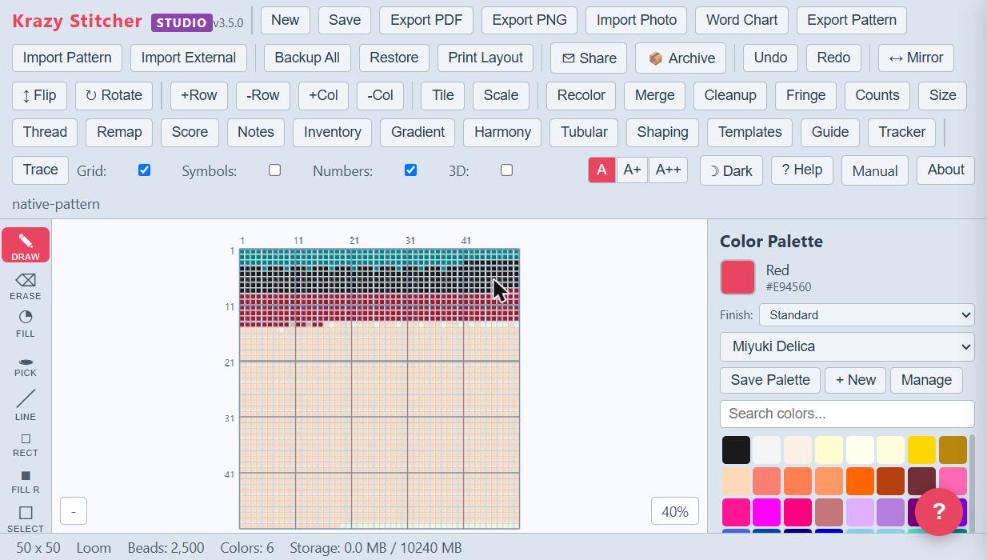
Peyote stitch, also called gourd stitch, is a bead weaving technique where beads interlock in an offset brick-like pattern. In flat peyote, you work back and forth in rows, with each bead sitting between two beads in the previous row. Even-count peyote is the simplest form: you start with an even number of beads and the turn at each row end is straightforward. Odd-count peyote requires a figure-eight turn on alternating rows, which is trickier but lets you create symmetrical designs with a center column. Tubular peyote wraps the same stitch around a form like a dowel or pen, creating seamless tubes perfect for beaded beads, vessel covers, and pen wraps. Drop counts (2-drop, 3-drop, and up) use multiple beads per stitch unit, making the work grow faster at the cost of reduced detail. Most bead pattern software, including Krazy Stitcher, supports even-count flat peyote and tubular peyote as separate stitch types, each with its own grid geometry.
Choose Your Edition
From hobbyist to power user, there is a Krazy Stitcher for every beader.
60-Day Free Trial
Krazy Stitcher
$24.95 one-time (Intro: $19.95) — 60-day trial, no account required
- 22 stitch types (peyote, brick, loom, RAW, spiral rope, netting, and more)
- Turn any photo into a bead pattern with smart color matching
- PDF, PNG, and word chart export
- Full shape toolkit: draw, fill, line, rectangle, oval, triangle, diamond
- Pattern search and project library
- Password-protect patterns before you share them
- 100% offline and private
Krazy Stitcher Pro
$34.95 one-time — no subscription
- Everything in Base, plus:
- 25 stitch types (3 additional — Ladder Stitch, Albion Stitch, Bead Crochet Rope)
- Rotatable 3D preview and live symmetric drawing
- Palette brand remapping (Miyuki, Toho, Preciosa)
- Real SVG and CSV export
- Color Reduction (Median Cut / Bayer dithering) and 300 DPI hi-res export
- Enhanced Backup: automatic Version History + Chromium folder auto-export
- Gradient fill and text overlay
- Bead inventory tracking and cost estimator
- Difficulty scoring
- Recolor and merge similar colors
- Fringe editor and bead shaping
- Tubular stitch support
- Print layout with pagination
- Pattern notes and annotations
- Tiling and repeat mode
- Guide overlay
- Row-by-row work tracker
Krazy Stitcher Studio
$59.95 one-time — no subscription
- Everything in Pro, plus:
- Color harmony engine
- Templates library
- Pattern scale tool
- Import external formats (BeadTool, CSV)
- Stitch-along autoplay
- Advanced layer system
- Multi-pattern workspace
- Batch Export: multi-pattern PDF/PNG to one .zip
- Batch Photo Import: convert multiple photos into patterns in one pass
- Bulk/wholesale distribution & pattern-book publishing rights
Each license covers personal use on up to 3 devices you own. Need more? Additional licenses are inexpensive — and schools, guilds, and other institutions can inquire about quantity pricing. Bringing Krazy Stitcher into a classroom or library computer lab? See our lab & classroom FAQ.
See It in Action
No guessing — here's exactly what you get.
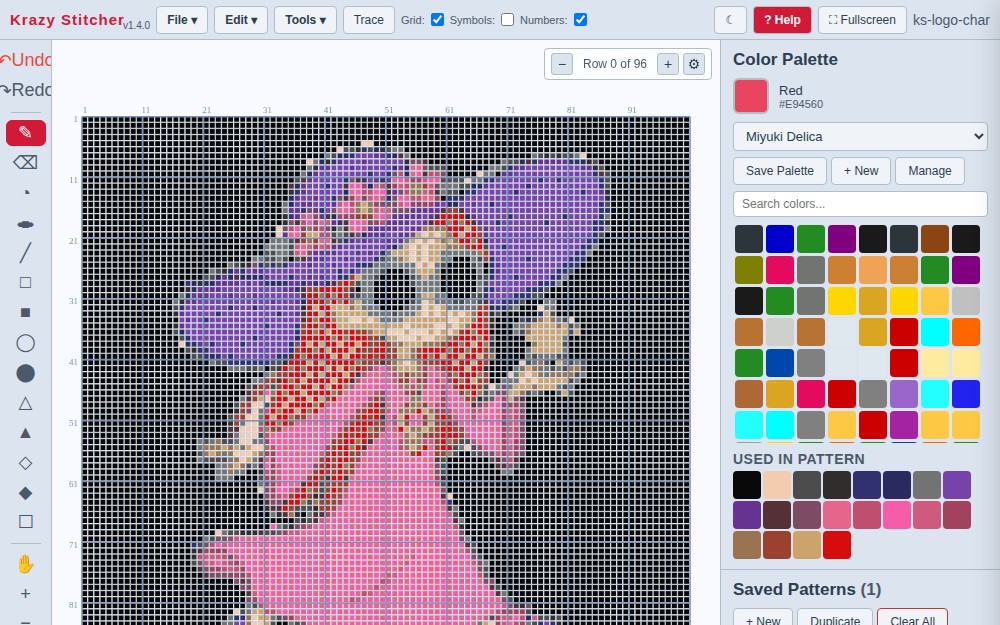
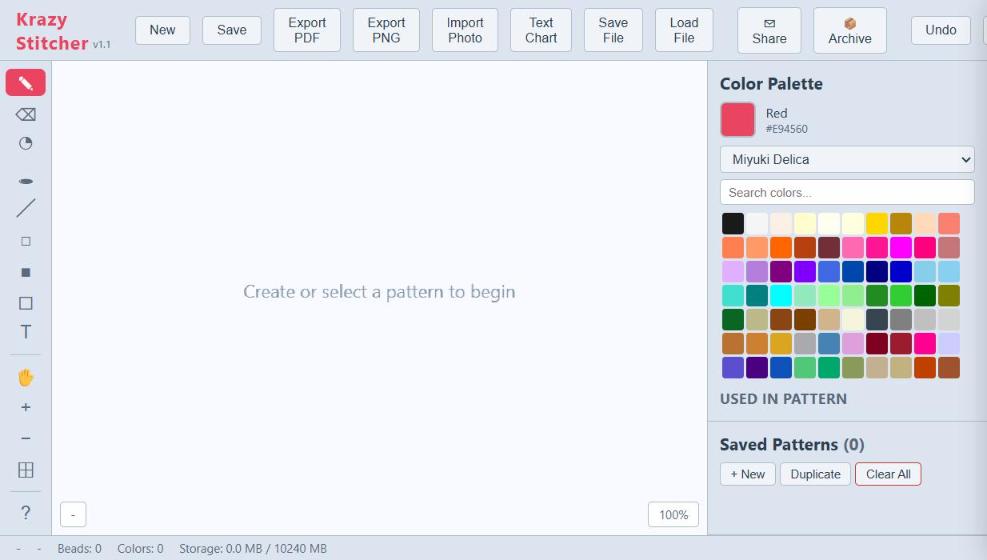
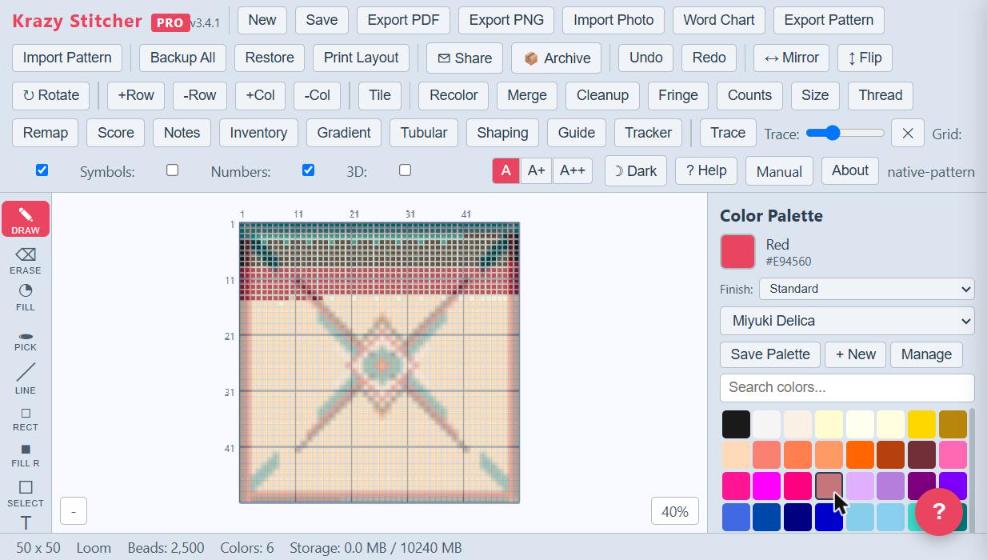
Design in a clean, visual editor
Pick your stitch, choose your colors, and start placing beads. Every tool is one click away — no menus to memorize.
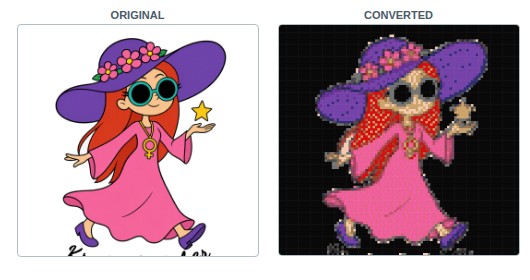
Turn any photo into a pattern
Import a picture and watch it become a stitchable design — with the exact bead colors you need to buy.
Coming Soon
See it before you stitch it
The 3D preview shows your pattern with realistic bead shapes — rounded cylinders with highlights and shadows. Know exactly what it'll look like in your hands.
Coming Soon
Export and start stitching
Print a clean PDF pattern with color legend and bead counts, a row-by-row word chart, or a high-res image. Take it to your beading table or share with a friend.
Everything You Need. Nothing You Don't.
55+ features in a single file that works on your computer — no internet needed, no installs, no updates, no accounts. Just your patterns, on your machine, completely private.
Every Stitch You Use — and the Ones You've Been Wanting to Try
If you've ever wanted to design a netting collar, a spiral rope necklace, or a Dutch spiral bracelet and your current software couldn't do it — Krazy Stitcher can.
Base covers the essentials and then some: even-count peyote (2-drop through 9-drop), brick stitch, loom, right-angle weave, herringbone, square stitch, gourd stitch, spiral rope, Dutch spiral, netting, and more — 22 stitch types total.
Pro & Studio add 3 more: Ladder Stitch, Albion Stitch, and Bead Crochet Rope.
That's 25 stitch types — more than most bead software on the market. Each one has its own accurate grid, so your bead counts and finished dimensions are right before you pick up a needle. (CRAW, Chenille Stitch, Triangle Weave, and St. Petersburg Chain are on the roadmap but not available in any edition yet.)
Turn Any Photo into a Bead Pattern
Drop in any photo — your cat, a landscape, a family portrait. Adjust brightness and colors, then choose how you want the beads matched: Smooth Blend scatters bead colors to create natural-looking transitions (great for photos), while Clean Color groups similar shades together for bold, graphic results. Try both and pick what looks right.
Palette Brand Remapping
Remap your entire pattern to Miyuki Delica, Toho, or Preciosa with one click. See exactly which beads to buy before you start.
Export Everywhere
PDF patterns, PNG images, word charts, and .ks project files. Print, share, or pick up where you left off.
Smart Tools That Save You Time
See how hard a pattern is before you start. Check your bead count and finished size. Clean up stray single beads that don't belong (beaders call this "confetti"). Merge similar colors, mirror your design, flip, rotate — all the tools you wish graph paper had.
Your Patterns Stay on Your Computer
Krazy Stitcher is a single file you save to your machine. No cloud storage of your patterns, no account required — your designs never leave your device. If the app hits an unexpected error, it sends us an anonymous technical report so we can fix bugs (see our Privacy Policy) — nothing else is ever tracked. It works with or without internet — once you have the file, you never need to be online.
3D Realistic Preview
See your pattern as it will actually look with realistic bead shapes — rounded cylinders with highlights and shadows. Toggle between grid and preview instantly. (Pro & Studio only)
Bead Inventory & Cost Estimator
Track your bead stock, see what you need to buy, and estimate project cost before you start. Inventory auto-deducts when you begin a pattern.
Row Work Tracker
Track your stitching progress row by row. Mark completed rows, see your percentage done, and pick up exactly where you left off.
Pattern Search & Filter
Find any saved pattern instantly by name. Search and filter your project library as it grows — no more scrolling through dozens of patterns.
Gradient Fill & Text Overlay
Generate smooth color gradients across your pattern and stamp text in pixel fonts. Add names, dates, or messages to any design.
Split & Recompose
Working on something oversized? Split a large pattern into a grid of tiles you can stitch one at a time, then recombine them into the finished whole. (Pro & Studio only)
Automatic Folder Backup
Point Krazy Stitcher at a folder on your computer — including a Dropbox, OneDrive, or iCloud folder — and every save automatically exports a snapshot there too, on top of manual backups and rolling version history. (Pro & Studio only, Chrome/Edge)
Print Layout & Backup
Generate paginated print layouts for large patterns. Backup and restore your entire project library with a single click.
How We Stack Up
Compare Krazy Stitcher with the most popular bead pattern tools on the market.
| Feature | Krazy Stitcher | BeadTool 4 ($49.95) | Beadographer ($14.99/yr) | Stitchmate ($4.99/mo) |
|---|---|---|---|---|
| Price | $19.95 intro | $49.95 | $14.99/yr | $4.99/mo |
| Works on your computer | ✓ | ✗ | ✓ | ✓ |
| Works offline | ✓ | ✓ | ✗ | ✗ |
| Stitch types | Up to 25 | 10+ | 6 | 8 |
| Photo import | ✓ | ✓ | ✓ | ✓ |
| Smart color blending for photos | ✓ | ✗ | ✗ | ✗ |
| Match to real bead brand colors | ✓ | ✗ | ✗ | ✗ |
| Difficulty scoring | ✓ | ✗ | ✗ | ✗ |
| 3D realistic preview | ✓ | ✗ | ✗ | ✗ |
| Bead inventory tracking | ✓ | ✗ | ✗ | ✗ |
| Cost estimator | ✓ | ✗ | ✗ | ✗ |
| Row work tracker | ✓ | ✗ | ✗ | ✗ |
| PDF + PNG export | ✓ | ✓ | ✓ | ✓ |
| Total features | 55+ | 17 | 12 | 13 |
Add-Ons & Tools
Expand your Krazy Stitcher workflow with standalone tools that work alongside any edition.
Photo Converter
$59.95 one-time
Turn any photo into a bead-ready pattern. Smart color matching with two methods — Smooth Blend for natural photos, Clean Color for bold graphics. Preview results side by side before committing.
Learn more about Photo Converter →Color Palette Tool
Free
Browse, compare, and build custom bead palettes from Miyuki, Toho, Preciosa, and more. Plan your colors before you start a pattern.
Learn more about the Color Palette Tool →Krazy Stitcher Companion
Free
A phone-friendly reader for following a pattern while you bead. Open a .ks or .ksp file and step through it row by row — opens password-protected patterns too.
Learn more about Krazy Stitcher Companion →PatternFolio
Coming Soon
Organize, tag, and manage your pattern library. Search, filter, and keep your growing collection under control.
Learn more about PatternFolio →
Watch How It Works
Short walkthroughs — no tech talk, just beading.
Coming Soon
Your First Pattern in 2 Minutes
Open, pick a stitch, place some beads, export a printable PDF. That's it.
Coming Soon
Turn a Photo into a Pattern
Import a picture and watch it become a stitchable design in under a minute.
Coming Soon
Switching from BeadTool
Bring your existing patterns over — nothing gets lost, nothing gets deleted.
What Beaders Are Saying
Reviews Coming Soon
We're just getting started, so real reviews from real beaders are on the way. Tried Krazy Stitcher? We'd love to hear what you think — send your review or comments to info@krazystitcher.com.
Pattern Image
600 × 400px
600 × 400px
 Free Pattern of the Month
September 2026: Autumn Leaves Bracelet
A warm-toned peyote bracelet with falling maple leaves — perfect for your first fall project. Uses Miyuki Delica 11/0 in 8 colors. Finished size: 1" × 7".
Stitch: Even-count peyote
Skill: Beginner-friendly
Beads: ~1,200 Delicas
Learn the Craft
Expand your beading knowledge with these quick guides on stitches, techniques, and tools.
What Is Peyote Stitch?
The most popular off-loom bead weaving technique, used for bracelets, amulet bags, and sculptural pieces.
Brick Stitch Basics
A versatile off-loom stitch that looks like peyote rotated 90 degrees, with unique shaping advantages.
Brick stitch creates a pattern that looks identical to peyote stitch but rotated 90 degrees. The key difference is structural: in brick stitch, each bead is attached to the thread bridge between beads in the previous row, rather than passing through the beads themselves. This makes brick stitch excellent for shaping because you can easily increase or decrease at the edges of each row to create triangles, diamonds, and irregular shapes. Earrings and pendants are the most popular brick stitch projects because the technique naturally creates clean edges without extra finishing. Brick stitch is slightly slower than peyote because each bead requires its own stitch, but the shaping flexibility is worth it. In Krazy Stitcher, the brick stitch grid shows the characteristic offset pattern with the flat edges on the sides rather than top and bottom.
Why Does My Photo Conversion Look Blocky?
How Krazy Stitcher smooths out color transitions so your patterns look more like the original photo.
When you turn a photo into a bead pattern, the software has to go from millions of colors down to just the bead colors you can actually buy. That's a huge reduction, and it often makes smooth gradients look like harsh color blocks — stripes where there should be a sunset.
That's where color blending comes in. Instead of sharp lines between colors, the software scatters different-colored beads to trick your eye into seeing the shades in between — the same way a pointillist painting uses tiny dots of pure color to create the illusion of blending.
Krazy Stitcher gives you two options:
Smooth Blend spreads the color differences across neighboring beads, creating soft, organic transitions. Best for photographs and images with gradients.
Clean Color groups similar colors together and picks the single best bead match for each group. Best for logos, geometric designs, and anything with flat areas of solid color.
You can try both and compare side by side before you commit. For the full technical details, see our Glossary.
That's where color blending comes in. Instead of sharp lines between colors, the software scatters different-colored beads to trick your eye into seeing the shades in between — the same way a pointillist painting uses tiny dots of pure color to create the illusion of blending.
Krazy Stitcher gives you two options:
Smooth Blend spreads the color differences across neighboring beads, creating soft, organic transitions. Best for photographs and images with gradients.
Clean Color groups similar colors together and picks the single best bead match for each group. Best for logos, geometric designs, and anything with flat areas of solid color.
You can try both and compare side by side before you commit. For the full technical details, see our Glossary.
Choosing the Right Bead Size
How 11/0, 15/0, and 8/0 seed beads affect your pattern's finished dimensions and detail level.
Seed bead sizes use a counterintuitive numbering system: the larger the number, the smaller the bead. Size 11/0 (approximately 1.8mm) is the workhorse of bead weaving and the default for most patterns. Miyuki Delica 11/0 beads are the standard for peyote and brick stitch because their tubular shape produces perfectly flat, fabric-like beadwork. Size 15/0 beads (about 1.3mm) are roughly 30% smaller, allowing finer detail but requiring more beads, more time, and sharper eyesight. They are popular for intricate jewelry and dimensional beading. Size 8/0 beads (about 3mm) are much larger and work up fast, making them ideal for beginners, loom work, and large decorative pieces. The finished size of a pattern changes dramatically with bead size: a 50-column peyote pattern measures roughly 3.5 inches wide in 11/0 beads but over 5.5 inches in 8/0. Always check the finished-size calculator before you start stitching.
Color Theory for Bead Patterns
Complementary, analogous, and value contrast principles applied to bead weaving design.
Color theory applies to bead patterns just as it does to painting or graphic design, but with an important constraint: you are limited to the colors available in your bead brand's palette. Complementary colors (opposites on the color wheel, like blue and orange) create high contrast and visual energy. Analogous colors (neighbors on the wheel, like blue, teal, and green) produce harmonious, soothing designs. Value contrast is arguably more important than hue in bead patterns because small beads viewed from a distance blend together. A design with strong light-dark contrast reads clearly even from across the room, while a design using different hues at similar values can look muddy. When designing patterns, squint at your color choices or convert them to grayscale to check value contrast. Krazy Stitcher includes palette remapping tools that help you explore different color schemes while maintaining your pattern structure.
Loom vs Off-Loom Techniques
When to use a bead loom and when off-loom stitches are the better choice.
Loom beading and off-loom stitching produce similar-looking beadwork but use fundamentally different construction methods. A bead loom holds parallel warp threads under tension while you weave beads between them row by row. Loom work is fast, produces perfectly aligned grids, and is great for wide bracelets, belts, and wall hangings. The downside is finishing: you must weave in every warp thread individually, which can mean dozens of thread ends on a wide piece. Off-loom stitches like peyote, brick, and right-angle weave build the beadwork entirely with a single working thread. They are slower per bead but produce more flexible fabric, require no special equipment, and are portable. Off-loom stitches also allow shapes that are difficult on a loom, like curves, tubes, and three-dimensional forms. Most beaders learn both approaches and choose based on the project.
How Photo-to-Pattern Conversion Works
The technical pipeline behind turning a photograph into a stitchable bead pattern.
Photo-to-pattern conversion is a multi-step pipeline. First, the image is resized to your target grid dimensions, controlled by the Max Width setting. A 50-column pattern at 11/0 beads produces roughly a 3.5-inch-wide piece, so choose dimensions based on your desired finished size. Next comes color quantization: the software reduces the image from millions of colors to a manageable number, typically 8 to 30. Fewer colors mean simpler patterns with less confetti (isolated single-color beads); more colors preserve detail but increase complexity and bead inventory. After quantization, optional dithering scatters bead colors to simulate smooth transitions. Finally, the software maps each quantized color to the nearest available bead color in your chosen brand palette. Krazy Stitcher lets you adjust brightness, contrast, and saturation before conversion, and shows a preview so you can iterate before committing to a pattern.
Right-Angle Weave Explained
A versatile stitch that creates flexible, fabric-like beadwork with unique 3D potential.
Right-angle weave (RAW) is a bead stitch where four beads form a cross-shaped unit, with the thread passing through each bead at right angles to its neighbors. The resulting fabric is exceptionally flexible and drapes like cloth, making it ideal for bracelets, necklaces, and sculptural pieces. RAW can be worked flat or built into three-dimensional forms by connecting units on multiple axes. Cubic right-angle weave (CRAW) extends the concept into a solid bead tube that is popular for bangles and structural elements. Because each unit uses four beads, RAW patterns require more beads than peyote or brick stitch for the same area, but the fabric quality is worth it for wearable pieces. RAW is often embellished by adding accent beads on top of the base layer, creating rich textured surfaces. Krazy Stitcher supports RAW as a dedicated stitch type with its own grid layout and bead count calculations.
Netting Stitch: Airy, Elegant Beadwork
An open, lacy stitch family that drapes beautifully for necklaces, collars, and ornament covers.
Netting is one of the oldest and most versatile bead weaving techniques, producing open, lace-like fabric that drapes gracefully around curved surfaces. The stitch is defined by how many beads sit between each shared connecting bead: 3-bead netting creates a tight, dense mesh; 5-bead netting is the most common and produces a classic diamond-shaped openwork; 7-bead netting creates a loose, airy fabric ideal for ornament covers and vessel embellishments. The technique works beautifully for necklaces, collars, amulet bag bodies, and Christmas ornament covers because the open structure conforms to curves naturally. Horizontal netting is worked back and forth in rows, while vertical netting is worked top-to-bottom and is popular for fringe-style earrings and bag straps. Circular netting starts from a center ring and radiates outward, which is how most ornament covers and doilies are constructed. Krazy Stitcher supports Netting as a dedicated stitch type with a grid layout that shows the characteristic diamond openwork pattern, making it easy to plan color placement before you pick up a needle.
Cubic RAW and 3D Bead Stitching
How cubic right-angle weave builds solid, three-dimensional beadwork for bangles, pendants, and sculptural pieces.
Cubic right-angle weave (CRAW) takes the flat right-angle weave stitch into three dimensions by building bead cubes — six-sided units where each face is a ring of four beads. The result is a solid, structural bead tube with a satisfying heft that is completely different from the hollow tubes created by tubular peyote or herringbone. CRAW tubes are popular for bangles, thick necklace ropes, and architectural elements in statement jewelry. The stitch is worked by building one cube at a time, connecting each new cube to the previous one by sharing a wall. Once you understand the "top, side, side, side, bottom" rhythm of adding faces, the stitch becomes meditative and surprisingly fast. Color placement in CRAW follows predictable patterns: the top and bottom faces show most prominently, so placing accent colors there creates bold spirals and stripes visible from every angle. CRAW can also be worked in increasing and decreasing widths to create shaped forms like beaded beads, pendants, and sculptural objects. CRAW is on Krazy Stitcher's roadmap as a future dedicated stitch type with a flattened cube layout for planning color placement across all visible faces — it's not available in any edition yet.
Supplies & Resources
Everything you need to bring your patterns to life. Curated supplies from trusted brands on Amazon.
Affiliate Disclosure: The links below are Amazon affiliate links. If you purchase through them, Krazy Stitcher earns a small commission at no extra cost to you.
🔶 Miyuki Delica Seed Beads
The gold standard for bead weaving. Perfectly uniform tubular beads in 11/0 size — ideal for peyote, brick, and loom stitch. Available in hundreds of colors.
Shop Miyuki Delicas🧵 Fireline Beading Thread
Micro-fused braided thread made from Dyneema — the strongest fiber per diameter. Smoke grey color disappears in your work. The thread serious beaders swear by.
Shop Fireline Thread🔧 Bead Looms
Essential for loom stitch patterns. The Beadsmith Metal Bead Loom Kit includes everything to get started — loom, thread, needles, and beads.
Shop Bead Looms🔧 Beading Starter Kits
All-in-one kits with beads, needles, thread, and tools. Perfect for beginners or as gifts. Includes everything you need to start your first pattern.
Shop Starter Kits
Tips & Tricks
Quick reads from the beading table.
Photo Conversion
5 Ways to Reduce Confetti in Photo Conversions
Those random single beads driving you crazy? Here's how to clean them up before you stitch a single row.
Bead Selection
Miyuki vs. Toho vs. Preciosa: Which Beads to Choose
They're all 11/0 Delicas, right? Not exactly. Here's what actually matters when you pick a brand.
Sizing
How to Size a Bracelet Pattern (Without Wasting Beads)
Measure twice, buy once. A quick guide to getting the width and length right before you start.
Join the Krazy Stitcher Community
Share your patterns, get feedback, swap tips, and see what other beaders are creating. It's free, friendly, and full of people who speak your language.
Share finished work
Get pattern feedback
Monthly challenges
Tips from pros
Free to join. No spam. Just beaders helping beaders.
Start Designing in Three Easy Steps
No signup. No installation. No tech skills needed.
Click and Open
Click the "Try It Free" button. Krazy Stitcher opens right in your web browser — Chrome, Safari, Edge, whatever you already use. Nothing to install. Works on your computer, tablet, or phone.
Pick Your Stitch and Size
Choose peyote, brick, loom, or any of our other stitch types. Pick a preset for bracelets, earrings, or wall art — or set your own dimensions.
Design, Export, and Stitch
Place beads by clicking, or import a photo and let the software do the work. When you're happy, save your pattern as a printable PDF and head to your beading table.
Built by a Beader, for Beaders
Krazy Stitcher started because the bead software out there was either too expensive, too limited, or both. I wanted something with every stitch type I actually use, photo conversion that doesn't look terrible, and a price that doesn't insult my intelligence.
So I built it.
Every feature in Krazy Stitcher comes from hours at the beading table, not a product manager's whiteboard. The supplies page recommends vendors I actually buy from. The stitch types are ones I actually stitch. The photo converter exists because I got tired of squinting at blocky conversions from other tools.
If you have a question, a problem, or a feature idea, you're emailing the person who built it — not a support ticket queue.